● Case study · CRM platform
OPTIMA
A modular CRM, and AI quotes a human signs off. Every small business has its own trade, and its tool has to speak it. One shared core, modules for each trade, and generative AI kept inside a space it cannot leave.
- Client
- Burst IT
- Role
- CPO, product and design lead
- Team
- 2 developers, 2 product, 1 sales
- Research
- Seven industries
- Status
- In use, to be distributed
- Years
- 2025–2026
- Status
- Shipped
Context
Every CRM was built for someone else's industry.
At Burst IT we sold fast, adaptable software to small and mid-sized companies. Nearly all of them ran on a CRM, and every CRM on the market was tuned for a different trade.
Research
Seven industries, one question: what is actually common?
I interviewed teams in laboratory testing, hospital maintenance, transport and delivery rounds, school supplies wholesale, e-commerce, prospecting and tax advisory. Two companies in the same sector rarely needed the same tool, because their stakes were different.
Architecture
One core, modules on top.
● The call
What belongs in the shared core, and what stays a module?
The core holds what everyone needs: contacts, customer data, a tool that is easy to pick up. Everything that expresses a trade is a module on top. OPTIMA also runs Burst IT itself: invoicing and payouts between clients, freelancers and partners.
The shared core
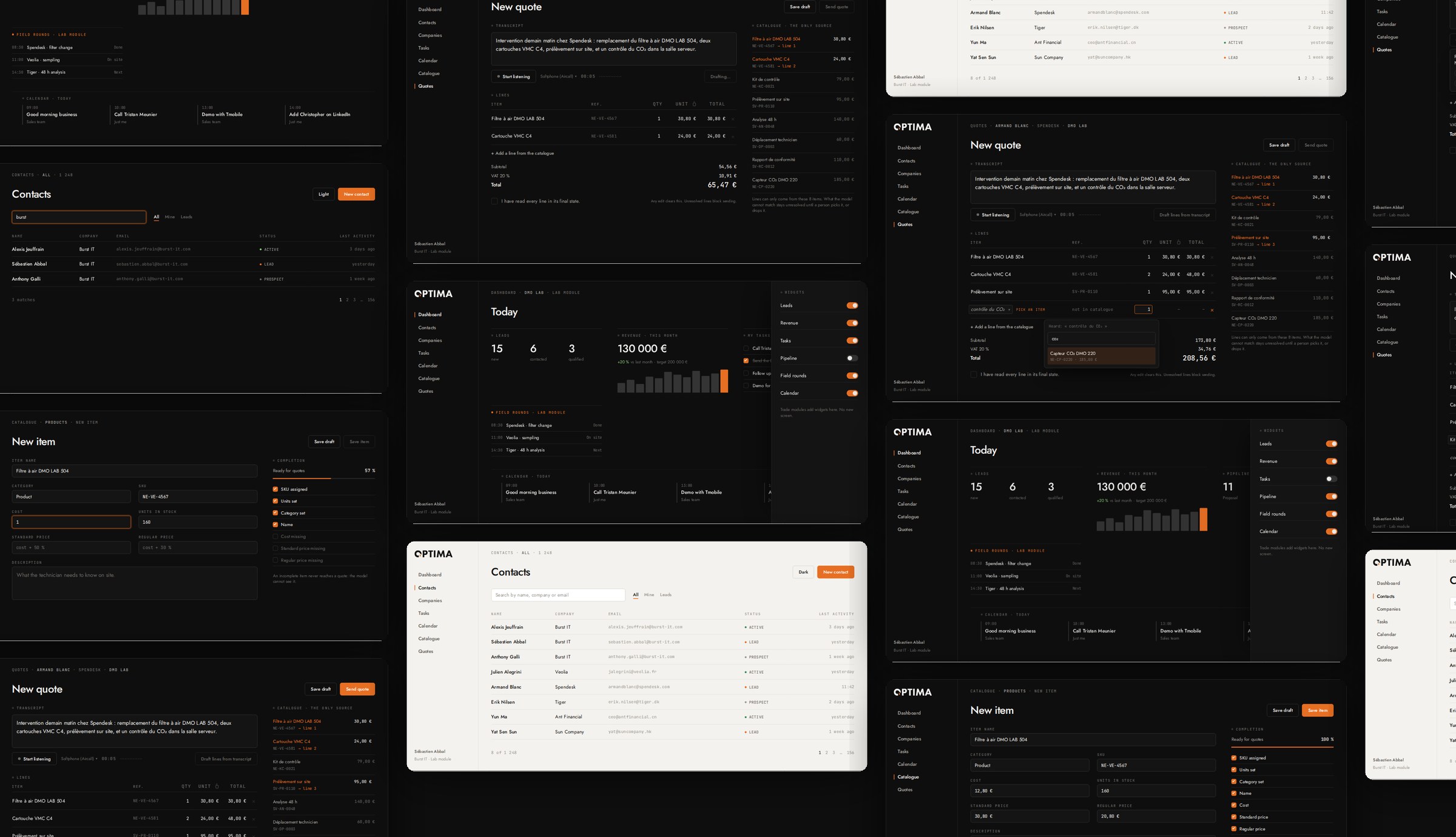
One dashboard, composed by the trade.
In numbers
Case 1 · A call becomes a quote
Dictated on the call. Fixed by a person. Sent.
Case 2 · The kit leaves, the stock follows
Assigned on the map. Reordered before it runs out.
OPTIMA ranks three technicians on drive time, skills, free time and kit; the planner assigns and the van leaves. In the depot, the slot that runs low is reordered, and the stock goes up when the pallet is scanned in.
Case 3 · On site, the office sees everything
The tablet in the field, the record at head office.
A count fails: the tablet flags it, the technician checks the seal and measures again, and the office sees both. Signed on the tablet, the report writes itself, and the room’s next requalification moves six months on.
Case 4 · Another trade, same core
A school supply list becomes an order, then a delivery round.
The list is read against the catalogue and multiplied by the pupils; two lines wait for a person. On the real roads of Lyon the rounds are optimised: about 30 % fewer kilometres, every school served outside class hours.